i’m entitled to my opinion (circular reasoning)

I’m entitled to my opinion or I have a right to my opinion is a common declaration in rhetoric or debate that can be made in an attempt to persuade others to hold the opinion. When asserted for this reason, the statement exempifies an informal logical fallacy of the type red herring. Whether one has a particular entitlement or right is irrelevant to whether their assertion is true or false. To assert the existence of the right is a failure to assert any justification for the opinion.

Times (UK) article on same: http://www.timesonline.co.uk/tol/comment/columnists/guest_contributors/article467194.ece?token=null&offset=0&page=1

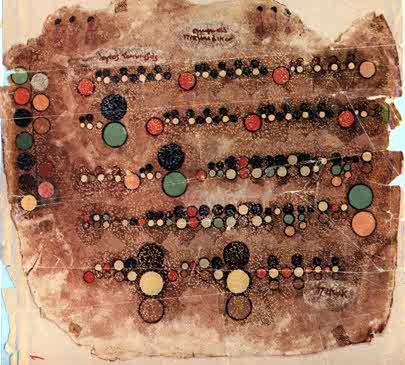
coptic music manuscript

manuscript ink on vellum, circa 8th century

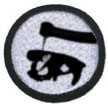
What the bright circles on this page mean no one absolutely knows.

The six words written on this page are in Coptic once the common tongue of Egyptian Christians. The words at the top mean “spiritual music”. Those below and to the left mean “sacred hymn singer.” Below these, a word states simply, “beginning,” and one at the foot of the page reads “end.”

http://typophile.com/node/42679

bloomsday

What parallel courses did Bloom and Stephen follow returning?

Starting united both at normal walking pace from Beresford place they followed in the order named Lower and Middle Gardiner streets and Mountjoy square, west: then, at reduced pace, each bearing left, Gardiner’s place by an inadvertence as far as the farther corner of Temple street: then, at reduced pace with interruptions of halt, bearing right, Temple street, north, as far as Hardwicke place. Approaching, disparate, at relaxed walking pace they crossed both the circus before George’s church diametrically, the chord in any circle being less than the arc which it subtends.

Inasmuch as leaning she sustained her blond hair for him to ribbon it for her (cf neckarching cat). Moreover, on the free surface of the lake in Stephen’s green amid inverted reflections of trees her uncommented spit, describing concentric circles of waterrings, indicated by the constancy of its permanence the locus of a somnolent prostrate fish (cf mousewatching cat).

What moved visibly above the listener’s and the narrator’s invisible thoughts?

The upcast reflection of a lamp and shade, an inconstant series of concentric circles of varying gradations of light and shadow.

science scout badges duly earned

From left to right: The that’s right people, I’m an artist, but I do science-y art and it’s cool badge. The I could tell you about my research, but then I’d have to kill you badge. The I use twitter to spread science badge. The astronaut badge (LEVEL I). Whereby the recipient has used a spacecraft simulator. The astronaut badge (LEVEL II). Whereby the recipient has actually been aboard a spacecraft. The non-explainer badge (LEVEL I). Where the recipient can no longer explain what they do to their parents. The I’ve set fire to stuff badge (LEVEL I). In which the recipient has set fire to stuff, all in the name of general scientific curiosity. The science has forced me to seek medical attention badge. The have used a dental drill and I’ve never been a dentist badge. The world’s foremost expert on an obscure subject badge. The I’m into telescopes astro badge (LEVEL I). The I can say ‘Danger: High Voltage!’ (or something to that effect) in more than one language badge.

http://www.scq.ubc.ca/sciencescouts/

manual of engineering drawing (1911)

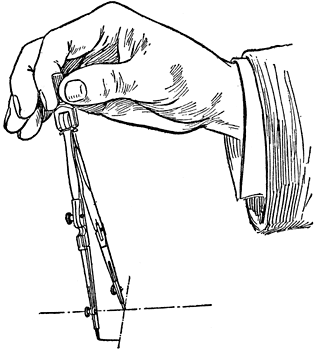
By the term Engineering Drawing is meant drawing as used in the industrial world by engineers and designers, as the language in which is expressed and recorded the ideas and information necessary for the building of machines and structures; as distinguished from drawing as a fine art, as practised by artists in pictorial representation.

The artist strives to produce, either from the model or landscape before him, or through his creative imagination, a picture which will impart to the observer something as nearly as may be of the same mental impression as that produced by the object itself, or as that in the artist’s mind. As there are no lines in nature, if he is limited in his medium to lines instead of color and light and shade, he is able only to suggest his meaning, and must depend upon the observer’s imagination to supply the lack.

The engineering draftsman has a greater task. Limited to outline alone, he may not simply suggest his meaning, but must give exact and positive information regarding every detail of the machine or structure existing in his imagination. Thus drawing to him is more than pictorial representation; it is a complete graphical language, by whose aid he may describe minutely every operation necessary, and may keep a complete record of the work
for duplication or repairs.

In the artist’s case the result can be understood, in greater or less degree, by any one. The draftsman’s result does not show the object as it would appear to the eye when finished, consequently his drawing can be read and understood only by one trained in the language.

When this language is written exactly and accurately, it is done with the aid of mathematical instruments, and is called mechanical drawing. When done with the unaided hand, without the assistance of instruments or appliances, it is known as freehand drawing, or technical sketching. Training in both these methods is necessary for the engineer, the first to develop accuracy of measurement and manual dexterity, the second to train in comprehensive observation, and to give control and mastery of form and proportion.

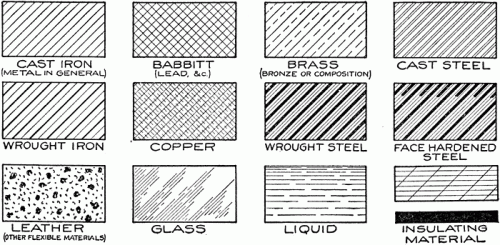
Our object then is to study this language so that we may write it, express ourselves clearly to one familiar with it, and may read it readily when written by another. To do this we must know the alphabet, the grammar and the composition, and be familiar with the idioms, the accepted conventions and the abbreviations.

This new language is entirely a graphical or written one. It cannot be read aloud, but is interpreted by forming a mental picture of the subject represented; and the student’s success in it will be indicated not alone by his skill in execution, but by his ability to interpret his impressions, to visualize clearly in space.
 

http://www.archive.org/stream/manualofengineer00frenrich/manualofengineer00frenrich_djvu.txt

brought to you by canada dry

movable type: immovable figura

Typecases (holders for individual pieces of movable type) from the China Printing Museum in Beijing, the largest printing museum in the world.  Although movable type was introduced into the Western world by Gutenberg, the process was invented in China centuries prior.

I visited the museum in July 2009 and there were three floors plus a huge warehouse of obsolete printing machines, incl. some massive newspaper offset ones. But there were no other visitors and they initially sent me up a pitch black staircase to the third floor. I used my feet to find the stairs in an eerie hesitant shuffle. I wasn’t allowed to take pictures. A woman was assigned to quietly follow me through the museum.

Wooden movable type was first developed around 1040 AD by Bi Sheng(毕昇) (990–1051), as described by the Chinese scholar Shen Kuo (1031–1095), but was abandoned in favour of clay movable types due to the presence of wood grains and the unevenness of the wooden type after being soaked in ink. In 1298, Wang Zhen, a governmental official of Jingde, Anhui province, China, re-invented a method of making movable wooden types. He made more than 30,000 wooden movable types and printed 100 copies of Records of Jingde County (旌德县志), a book of more than 60,000 Chinese characters. Soon afterwards, he summarized his invention in his book A method of making moveable wooden types for printing books. Although the wooden type was more durable under the mechanical rigors of handling, repeated printing wore the character faces down, and the types could only be replaced by carving new pieces. This system was later enhanced by pressing wooden blocks into sand and casting metal types from the depression in copper, bronze, iron or tin. The set of wafer-like metal stamp types could be assembled to form pages, inked, and page impressions taken from rubbings on cloth or paper.

A particular difficulty posed the logistical problems of handling the several thousand characters whose command is required for full literacy in Chinese. http://en.wikipedia.org/wiki/Movable_type

umbrellas entering the forbidden en masse (Beijing)

cartwheel: 10

there’s due course then there’s also a fixed lack of relative position spiral delicious over black angled highway there’s coursework to be done

you lost your maps I pinned them to your black pants you still lost them you didn’t care

I play pick-me-up with bits of this and that and those I can’t remember if we’ll get there in due course

suspended, disbelief flutters on guides by wire airplane engine conks out then kicks in

 trace my outline across a prairie then re-name me, hide m__   _____

                                                                                         ok disgeneral tendencies distinctive features in amongst is it enough that I am sorry for the harm I am not saying it was okay but maybe I had it coming

aped mimic of the right evolved things to say to forgive is divine to let go to throw the baby out with the bathwater cradle on the rocks ghostprint bassinet ether give me more ether

if a growth chart then a stunting unaccounted for a premise of forgettables we do not live we do not grow only hip skip stop drop hiccup

if you use the right words but don’t believe them if you use the right words for wrong reasons then it’s better not to speak at all better to de-evolve a mouth into slitwork but of course I am not an expert in speaking I am a beautiful relic i don’t mind telling you

you are accumulated sad a shine off the bumper a part of the highway I tried to avoid oil slick birds a locus mis-focus barren hen squawking merge where possible

over some city I smile I see  the furthest focal I do not want to land ever I do not remember anything anymore the eternal sunspots of the shyness kind

you misunderstand me it was not okay but could be maybe but then kindness is kidness is unfolding volute eye spiralled treads of tires tarmac iliac seeds we are all nothing there is only this

see you on the moon

tangential

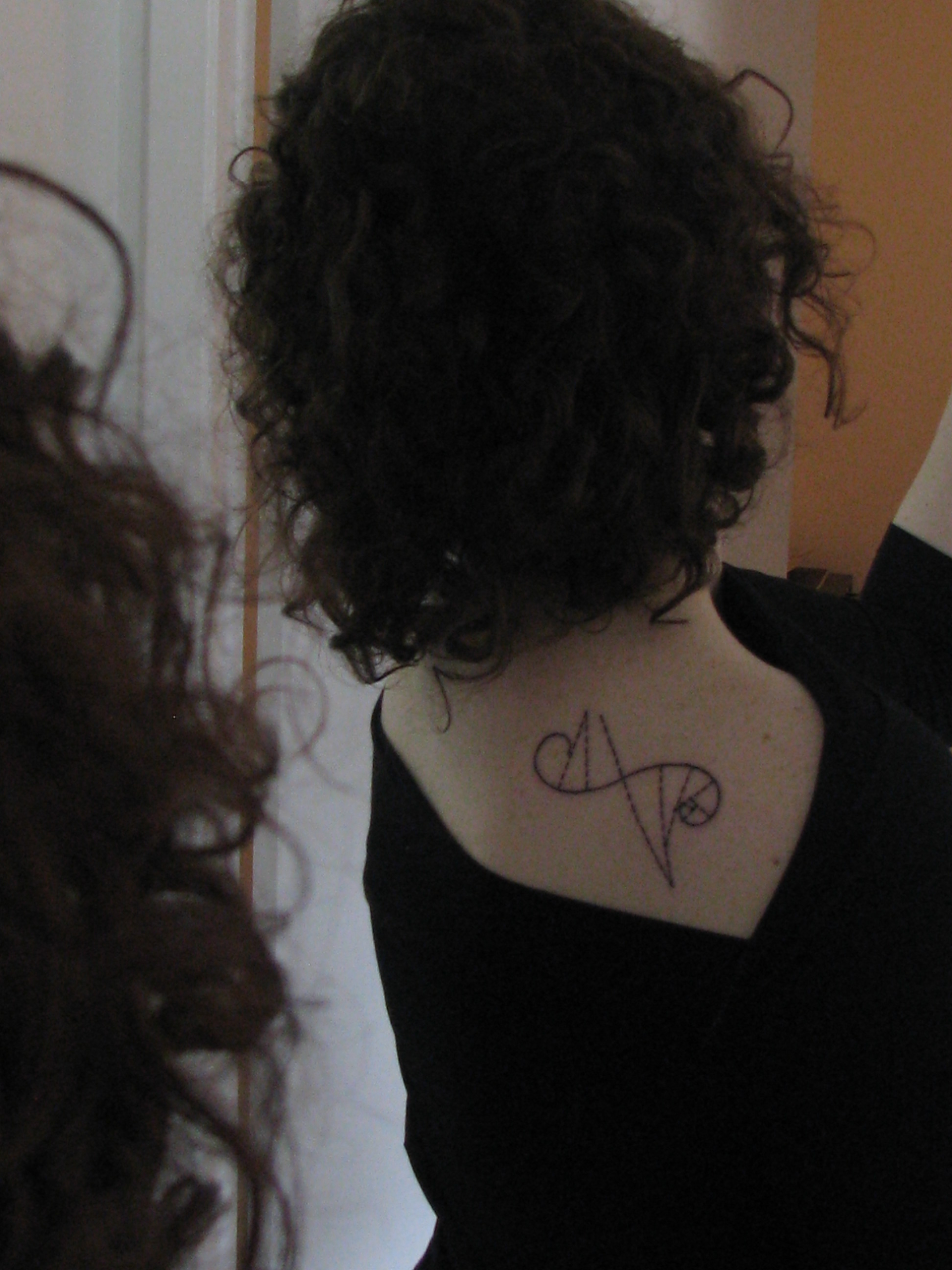
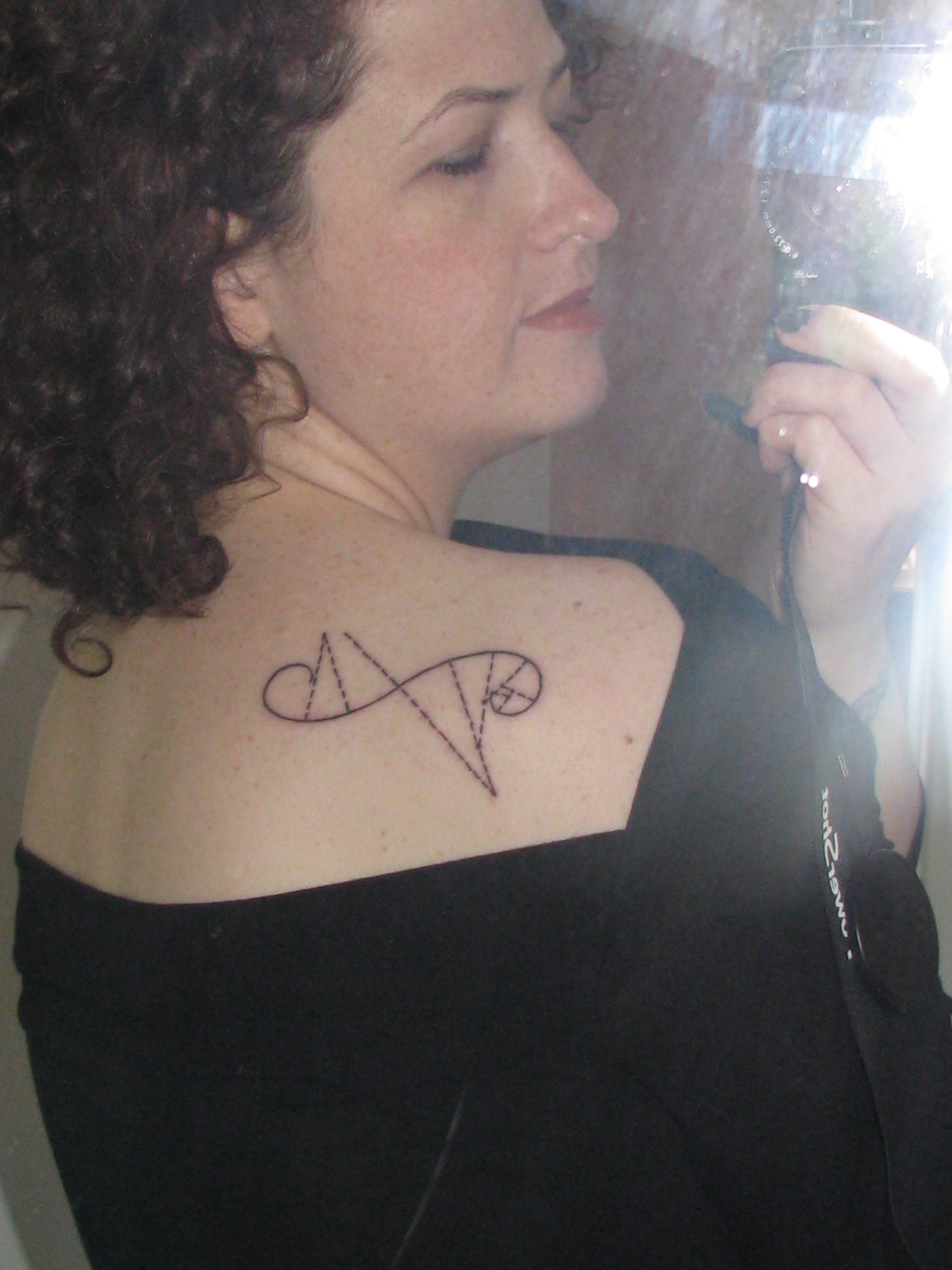
(first image is a mirror-image, reversal of fortunes)

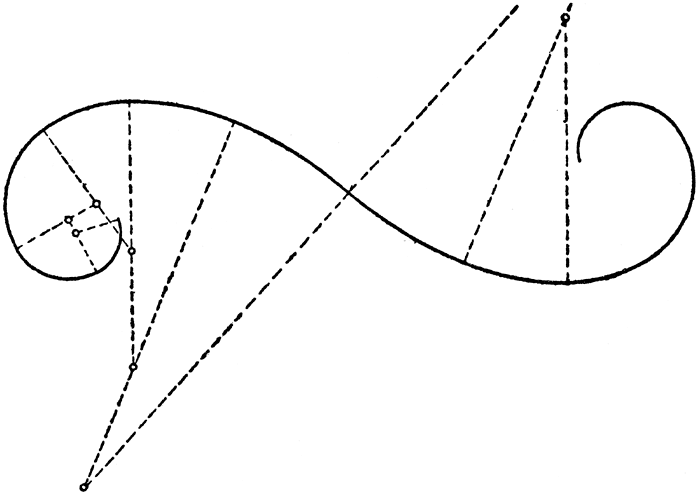
Any noncircular curve may be approximated by tangent circle arcs, selecting a center by trial, drawing as much of an arc as will practically coincide with the curve, then changing the center and radius for the next portion, remembering always that if arcs are to be tangent, their centers must lie on the common normal at the point of tangency. — French, Thomas E. A Manual of Engineering Drawing for Students and Draftsmen (New York: McGraw-Hill, 1911) 54