did you know how much?

I See a Darkness – Bonnie Prince Billy


well you’re my friend
(it’s what you told me)
and can you see
(what’s inside of me)
many times
we’ve been out drinking
and many times
we’ve shared our thoughts
but did you ever, ever notice
the kind of thoughts I got
well you know I have a love
a love for everyone I know
and you know I have a drive
to live I won’t let go
but can you see its opposition
comes a-rising up sometimes
that it’s dreadful and position
comes blacking in my mind
and that I see a darkness
and did you know how much I love you
is a hope that somehow you you
can save me from this darkness
well I hope that someday, buddy
we have peace in our lives
together or apart
alone or with our wives
that we can stop our whoring
and pull the smiles inside
and light it up forever
and never go to sleep
my best unbeaten brother
this isn’t all I see

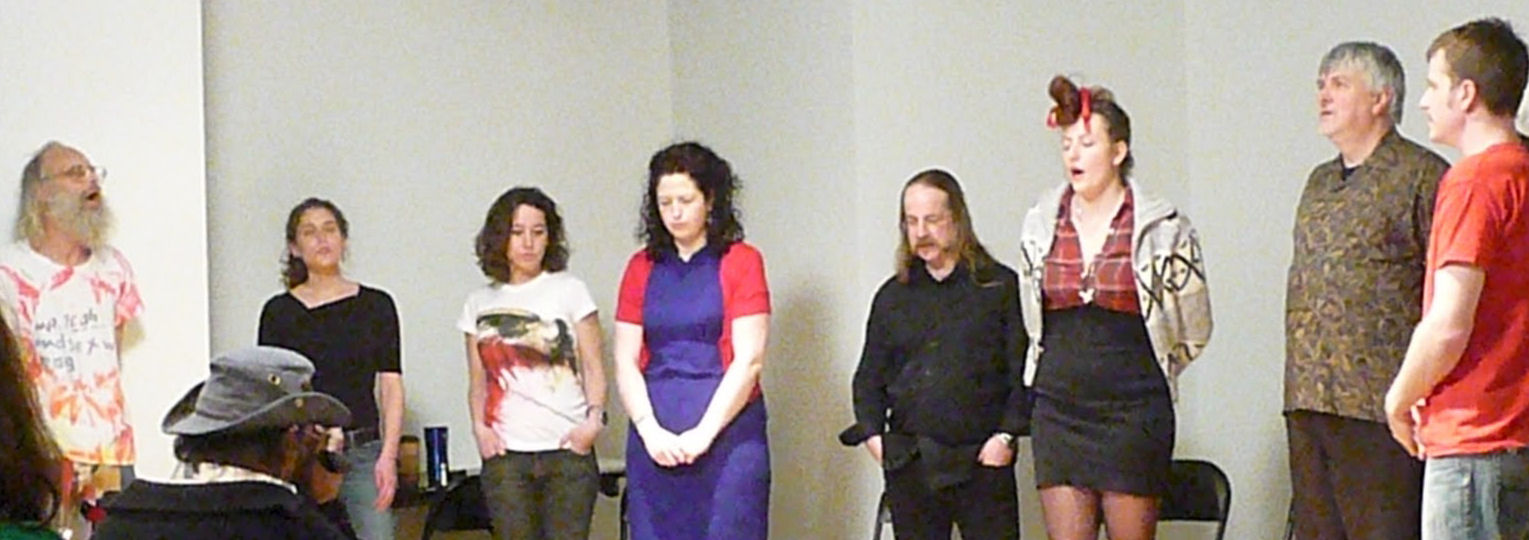
Messagio Galore take VIII mukluk


photo by rob mclennan

event report by rob mclennan: http://robmclennan.blogspot.com/2011/05/messagio-galore-take-viii-event-report.html

Amanda Earl’s comments on WritersFestival highlights: http://amandaearl.blogspot.com/2011/05/wore-down-trust-fest-highlights.html

John W. MacDonald’s photo of jwcurry: http://weblog.johnwmacdonald.com/2011/05/jwcurry-messagio-galore-viii.html

practice when there’s no practice: Messagio Galore take VIII


Ages since I’ve been able to update the blog, worn out by all the Many Whatsits. Currently knee deep in practices for Messagio Galore take VIII. It’s part of the Ottawa International Writers Festival on Sunday May 2nd (2pm, Mayfair Theatre).

You can a description for the previous Messagio Galore here, which includes links about previous incarnations. There’s also a round-up of reviews and blogposts here.

For fun, thought I’d list off some of the stuff that I’ve been watching or listening to over the past year or so when I’m not practicing at john’s house. We started practices for Messagio Take VII, in April 2010, perhaps? Even when we’re not practicing: we’re practicing.

Lots of Mary Margaret O’Hara. I like how she tosses her voice around and chirps and I have tried to flourish some of that.

Don’t Be Afraid” Mary Margaret O’Hara

Bulgarian singing. John turned me on to this. I’ve bought a few albums and he played me a tape accompanying the Musicworks magazine (#44) featuring bpNichol/Schwitters and Bulgarian singing. He introduced me this form of singing as a way of trying to get me to sing certain pieces with a more open throat. Particularly the flourish that I had to do in “Mescal Rite”. My first exposure was when he played me Le Mystere des Voix Bulgares. The ninth song on the album, “Sableyalo Mi Agontze”, isn’t online but it’s my favourite. Tears my guts out and I nearly always cry when I hear it. I subsequently wandered through the youtubeisms and through other online videos and into other regional varieties of the same.

Malka Moma” Mystere de Voix Bulgares
Lale li si Zumbiul li si” Galina Durmushliiska
Not Sure, Шопска Китка ” Singers not attributed in English
Title not Listed” Mystere de Voix Bulgares
Zaidi Zaidi jasno slance” Iva Davidova

Random assortment of things. Inuit singing when I was playing with running overtones and undertones and minimidtones, mainly within the privacy of my own home, to the concern of my furniture. The original Robert Ashley piece that was the basis for what we’ve tried with “She Was a Visitor” in the previous take. Four Horsemen.

Inuit Throat Singers, Ottawa 2008
Inuit Throat Singing, Aryaut and Aniksak
She Was a Visitor” Robert Ashley
From “Poetry in Motion” Four Horsemen

There’s also a boatload of sound and video files at UBUWeb that I meander through. And there’s Penn Sound. And Google hunting.

Kroetsch Award shortlist

Uber-pleased to be a finalist along with my co-Ottawans: Amanda Earl, Pearl Pirie, and Sandra Ridley for the Kroetsch Award for Innovative Poetry.

Pearl did a neat list with links of all the finalists.

* update: hurrah for Pearl who takes the ribbon! I’m much looking forward to her book: http://snarebooks.wordpress.com/2011/03/02/the-2011-robert-kroetsch-award-goes-to-pearl-pirie/

post-messagio mukluk


performance of She Was a Visitor, photo by rob mclennan

Messagio Galore (take VII) was much fun. I found the experience draining but exhilarating. I was ridiculously proud of us as a group, an entity, a coven, a cabal. I particularly loved the version of “She Was A Visitor“. Loved passing back high notes and hearing the soundscape wobble and working with an even larger group of friends. Quite pleased that I did not pass out or cough during “Artikulation”. Video recording indicates that I was sufficiently loud. Even VERY LOUD at points.

You can check out John W. MacDonald’s grouped photo of the event here. Also, rob mclennan and Pearl Pirie recorded their impressions of the event here and here. Much thanks to all three and to all who attended.

Messagio Galore is next week! Other things!

This week is a special kind of madness as Messagio Galore take VII draws near. I strongly recommend you show up if you’re in the Ottawa environs. Invite your friends! Drag strangers in to the reading while gesturing and/or offering them candy!

I’m still plugging away at the cartwheel chapbook anthology thing. I’m aiming to have it done like dinner for March. Reining in the dream machine.

I had a goodish time at my Voices of Venus reading on Tuesday. Metro Ottawa  had a Metro Minute listing for the show. I panicked and sent them a fairly awkward looking photo of me at a Peking duck restaurant in Beijing. Someone kindly picked up some print copies of the Metro in question for me and my Mum.

It was a good audience and the organisers were sweet. They made a quite nice looking poster using Charles Earl’s photograph of me.  I took one of the posters from the cafe wall after the reading.  Amanda Earl said some nice things about the reading on her literary blog.  I was able to spend time with some of my favourite people. Good all around really.  Nervy with lucky.

Messagio Galore take VII: January 23, 2011

an evening of sound poetry (& similar)
focussing on extended works & miniatures

featuring the voices of
jwcurry, Lesley Marshall, Christine McNair, Alastair Larwill, Grant Wilkins

reading work by:
Antonin Artaud
jwcurry
Alastair Larwill
bpNichol
Tomahawk
Robert Ashley
don sylvester houédard
Sam Loyd
Michèle Provost
Richard Truhlar
bob cobbing
Ernst Jandl
Franz Mon
Rob Read
Frank Zappa

Doors open at 7:00 pm, reading at 7:30 pm. $15 at the door (facebook invite)

Interview on December 23, 2010 with jwcurry about the upcoming performance (CKCU Literary Landscapes with Christine McNair): literary-landscapes-jw-curry

previous Messagio Galore readings:
Amanda Earl’s review of Messagio Galore take VI (2009)
Charles Earl’s photos from Messagio Galore take VI (2009) here and here
Pearl Pirie on Messagio Galore take VI (2009)
rob mclennan on Messagio Galore take VI (2009)
Messagio Galore photo gallery on AB series site
John W. MacDonald’s photo of Messagio Galore take V (2008)
Pearl Pirie’s post on Messagio Galore take V (2008)
Dee Shanger’s website for Messagio Galore  take IV (2007)
John W. MacDonald’s blog post on Messagio Galore (2005)
rob mclennan’s blog post on Messagio Galore (2005)

rise (By Grand Central Station I Sat Down and Wept)


“Under the redwood tree my grave was laid, and I beguiled my true love to lie down. The stream of our kiss put a waterway around the world, where love like a refugee sailed in the last ship. My hair made a shroud, and kept the coyotes at bay while we wrote our cyphers with anatomy. The winds boomed triumph, our spines seemed overburdened, and our bones groaned like old trees, but a smile like a cobweb was fastened across the mouth of the cave of fate.

Fear will be a terrible fox at my vitals under my tunic of behaviour.

Oh, canary, sing out in the thunderstorm, prove your yellow pride. Give me a reason for courage or a way to be brave. But nothing tangible comes to rescue my besieged sanity, and I cannot decipher the code of the eucalyptus thumping on my roof.

I am unnerved by the opponents of God, and God is out of earshot. I must spin good ghosts out of my hope to oppose the hordes at my window. If those who look in see me condescend to barricade the door, they will know too much and crowd in to overcome me.

The parchment philosopher has no traffic with the night, and no conception of the price of love. With smoky circles of thought he tries to combat the fog, and with anagrams to defeat anatomy. I posture in vain with his weapons, even though I am balmed with his nicotine herbs.

Moon, moon, rise in the sky to be a reminder of comfort and the hour when I was brave.”

— Elizabeth Smart (By Grand Central Station I Sat Down and Wept)

it can happen to anyone

male or female or straight or same-sex or or or or or or or or.

SIGNS THAT YOU’RE IN AN ABUSIVE RELATIONSHIP
Your Inner Thoughts and Feelings
Your Partner’s Belittling Behavior
Do you:
  • feel afraid of your partner much of the time?
  • avoid certain topics out of fear of angering your partner?
  • feel that you can’t do anything right for your partner?
  • believe that you deserve to be hurt or mistreated?
  • wonder if you’re the one who is crazy?
  • feel emotionally numb or helpless? 
Does your partner:
  • humiliate or yell at you?
  • criticize you and put you down?
  • treat you so badly that you’re embarrassed for your friends or family to see?
  • ignore or put down your opinions or accomplishments?
  • blame you for his own abusive behavior?
  • see you as property or a sex object, rather than as a person?
Your Partner’s Violent Behavior or Threats
Your Partner’s Controlling Behavior
Does your partner:
  • have a bad and unpredictable temper?
  • hurt you, or threaten to hurt or kill you? 
  • threaten to take your children away or harm them?
  • threaten to commit suicide if you leave?
  • force you to have sex?
  • destroy your belongings?
Does your partner:
  • act excessively jealous and possessive?
  • control where you go or what you do?
  • keep you from seeing your friends or family?
  • limit your access to money, the phone, or the car?
  • constantly check up on you?
http://helpguide.org/mental/domestic_violence_abuse_types_signs_causes_effects.htm

Writing Materials: On Parchment (The Saturday Magazine, vols 12-13, 1838)

A Lively French writer relates, that man having met the sheep wandering, like himself, upon the earth, caressed it, flattered it, and conducted it to his abode, sheltered it under a roof as rudely constructed as that which covered himself, carried it fresh grass for its food, and took care of it. But shortly, man demanded some milk of the sheep; soon after, he asked for a little wool; and, in the course of time, he killed it for its flesh. Having done all this, he melted down its fat to supply his lamp; and, finally, he wrote upon its skin.

The ancients seem to have substituted the skins of animals, for papyrus and other articles, as a writing material, from a remote period. The origin of parchment was due to necessity, the inventive parent of so many of the arts and conveniences of life; the stimulant of man’s ingenuity, when he suffers under present difficulties, or when he anticipates increased comfort and convenience. Some accounts refer the invention of parchment to a distant period, while others maintain that the date of its invention is altogether lost, amid the troubled waves of the broad ocean of distant time. According to the former, Eumenes attempted to found a library at Pergamus, about two hundred years B. C, which was to rival the celebrated Alexandrian library. One of the Ptolemies, a king of Egypt, jealous of the success of the rival library, and manifesting a spirit which, in modern times, would be thought pitiful and intolerant, made a decree, prohibiting the exportation of papyrus. The inhabitants of Pergamus, no longer being able to procure the material on which to transcribe the manuscripts to which their writers had access, adopted the skins of animals, prepared in a peculiar manner, as a substitute. They formed their library of this material, which was named after their city, Pergamena; whence also, it is supposed, we get our modern term parchment. The modern Germans and Italians, however, retain the original term: in the former language it is called Pergament, and in the latter Pergamena. The ancient Latins also applied the term membrana to parchment.

Some authorities, however, deny that parchment was first made at Pergamus; they state that the Hebrews had books written on the skins of animals in the time of David. According to Diodorus, the ancient Persians wrote all their records upon skins. It would appear, therefore, that King Eumenes was the improver, and not the inventor, of parchment. Dr. Prideaux imagines, that the authentic copy of the Law, which Hilkiah found-in the Temple, and sent to King Josiah, was written on parchment; because, he thinks, no other material could have been so durable as to last from the time of Moses till that period, viz. eight hundred and thirty years.’ But the Egyptians wrote on linen; which has been preserved on mummies for ages, and exists at the present day. It has, therefore, been suggested, that the copy of the Law of Moses might have been written on this material. At any rate, however, most of the ancient manuscripts which remain, are written on parchment; and bat few on the papyrus. Herodotus, however, who lived about four hundred and fifty years B. C, relates that the Ionians, from the earliest period, wrote upon goat and sheep skins, from which the hair had been scraped, without any other preparation.

Though the term roll occurs several times, yet parchment is not expressly mentioned more than once, and that by St. Paul (2 Tim. iv. 13), in the first age of the Christian era. Parchment seems to have been rather a scarce commodity until modern times. It was no uncommon thing, in the middle nges, to erase a beautiful poem, or a valuable history, merely for the sake of the parchment or vellum on which it is written. Many of the valuable writings of the ancients have been recovered from beneath a monkish effusion, or a superstitious legend, by carefully following the traces of the pen, or style, which had impressed the former performance upon the membrane; which traces had not been entirely obliterated by the second scribe. Persons who prepared parchment, by erasing a manuscript, were called “parchment restorers;” thus an old French writer says:—

Our parchment makers are very skilful. Our parchment restorers are not less so. Some parchment has been restored three or four times, and has successively received the verses of Virgil, the controversies of the Arians, the decrees against the books of Aristotle, and, finally, the books of Aristotle themselves.
Parchment is like an easy man, who is always of the same opinion as the last speaker.

The preparation of parchment is by no means a pleasant or cleanly operation. Our readers may, probably, have seen carts loaded with sheep-skins proceeding from large markets, or in the vicinity of slaughter-houses. These skins are bought of the butcher by the parchment-maker, in order to prepare, from them, the material in which he deals. The skins are first stripped of their wool, which is sold to the wool merchant, who prepares it for the making of cloth, &c. They are then smeared over with quick-lime on the fleshy side, folded once in the direction of their length, laid in heaps, and so left to ferment for ten or fifteen days.

The skins are then washed, drained, and half-dried. A man called the skinner stretches the skin upon a wooden frame. This frame consists of four pieces of wood, mortised into each other at the four angles, and perforated lengthways from distance to distance, with holes furnished with wooden pins that may be turned like those of a violin. The skin is perforated with holes at the sides, and through every two holes a skewer is drawn : to this skewer a piece of string is tied, as also to the pins, which being turned equally, the skin is stretched tight over the frame. The flesh is now pared off with a sharp iron tool, which being done, the skin is moistened and powdered with fine chalk: then, with a piece of flat pumice-stone, the remainder of the flesh is scoured off. The iron tool is again passed over it, and it is again scoured with chalk and pumice-stone. The scraping with the iron tool is called draining; and the oftener this is done, the whiter becomes the skin. The wool or hair side of the skin is served in a similar manner; and the last operation of the skinner is to rub fine chalk over both sides of the skin with a piece of lambskin that has the wool on: this makes the skin smoother, and gives it a white down or knap. It is left to dry, and is removed from the frame by cutting it all round.

The parchment-maker now takes the skin thus prepared by the skinner. He employs two instruments; a sharp cutting tool, sharper and finer than the one employed by the skinner; and the summer, which is nothing more than a calf-skin well stretched upon a frame. The skin is fixed to the summer; and the parchment-maker then works with the sharp tool from the top to the bottom of the skin, and takes away about one half of its thickness. The skin being thus equally pared on both sides, it is well rubbed with pumice-stone. This operation is performed upon a kind of form, or bench, covered with a sack stuffed with flocks; and this process leaves the parchment fit for writing on.

The paring of the skin in its dry state upon the summer, is the most difficult process in the whole art of parchment-making; and is only entrusted to experienced hands. The summer sometimes consists of two skins, and then the second is called countersummer. The parings and clippings of the skin in the preparation of parchment are used in making glue and size.

Vellum is’a kind of parchment made from the skins of young calves: it is finer, whiter and smoother than common parchment, but prepared in the same manner, except that it is not passed through the lime pit.
Parchment is coloured for the purposes of binding, &c. The green dye is prepared from acetate of copper (verdigris), ground up with vinegar with the addition of a little sap green. Yellow dye is prepared from saffron; a transparent red from brazil wood ; blue from indigo, ground up with vinegar ; black from the sulphate of iron and solution of galls. Virgin parchment, which is thinner, finer, and whiter than any other kind, and used for fancy work, such as ladies’ fans, &c, is made of the skin of a very young lamb or kid.