Category Archives: instructions

Writing Materials: On Parchment (The Saturday Magazine, vols 12-13, 1838)

A Lively French writer relates, that man having met the sheep wandering, like himself, upon the earth, caressed it, flattered it, and conducted it to his abode, sheltered it under a roof as rudely constructed as that which covered himself, carried it fresh grass for its food, and took care of it. But shortly, man demanded some milk of the sheep; soon after, he asked for a little wool; and, in the course of time, he killed it for its flesh. Having done all this, he melted down its fat to supply his lamp; and, finally, he wrote upon its skin.

The ancients seem to have substituted the skins of animals, for papyrus and other articles, as a writing material, from a remote period. The origin of parchment was due to necessity, the inventive parent of so many of the arts and conveniences of life; the stimulant of man’s ingenuity, when he suffers under present difficulties, or when he anticipates increased comfort and convenience. Some accounts refer the invention of parchment to a distant period, while others maintain that the date of its invention is altogether lost, amid the troubled waves of the broad ocean of distant time. According to the former, Eumenes attempted to found a library at Pergamus, about two hundred years B. C, which was to rival the celebrated Alexandrian library. One of the Ptolemies, a king of Egypt, jealous of the success of the rival library, and manifesting a spirit which, in modern times, would be thought pitiful and intolerant, made a decree, prohibiting the exportation of papyrus. The inhabitants of Pergamus, no longer being able to procure the material on which to transcribe the manuscripts to which their writers had access, adopted the skins of animals, prepared in a peculiar manner, as a substitute. They formed their library of this material, which was named after their city, Pergamena; whence also, it is supposed, we get our modern term parchment. The modern Germans and Italians, however, retain the original term: in the former language it is called Pergament, and in the latter Pergamena. The ancient Latins also applied the term membrana to parchment.

Some authorities, however, deny that parchment was first made at Pergamus; they state that the Hebrews had books written on the skins of animals in the time of David. According to Diodorus, the ancient Persians wrote all their records upon skins. It would appear, therefore, that King Eumenes was the improver, and not the inventor, of parchment. Dr. Prideaux imagines, that the authentic copy of the Law, which Hilkiah found-in the Temple, and sent to King Josiah, was written on parchment; because, he thinks, no other material could have been so durable as to last from the time of Moses till that period, viz. eight hundred and thirty years.’ But the Egyptians wrote on linen; which has been preserved on mummies for ages, and exists at the present day. It has, therefore, been suggested, that the copy of the Law of Moses might have been written on this material. At any rate, however, most of the ancient manuscripts which remain, are written on parchment; and bat few on the papyrus. Herodotus, however, who lived about four hundred and fifty years B. C, relates that the Ionians, from the earliest period, wrote upon goat and sheep skins, from which the hair had been scraped, without any other preparation.

Though the term roll occurs several times, yet parchment is not expressly mentioned more than once, and that by St. Paul (2 Tim. iv. 13), in the first age of the Christian era. Parchment seems to have been rather a scarce commodity until modern times. It was no uncommon thing, in the middle nges, to erase a beautiful poem, or a valuable history, merely for the sake of the parchment or vellum on which it is written. Many of the valuable writings of the ancients have been recovered from beneath a monkish effusion, or a superstitious legend, by carefully following the traces of the pen, or style, which had impressed the former performance upon the membrane; which traces had not been entirely obliterated by the second scribe. Persons who prepared parchment, by erasing a manuscript, were called “parchment restorers;” thus an old French writer says:—

Our parchment makers are very skilful. Our parchment restorers are not less so. Some parchment has been restored three or four times, and has successively received the verses of Virgil, the controversies of the Arians, the decrees against the books of Aristotle, and, finally, the books of Aristotle themselves.
Parchment is like an easy man, who is always of the same opinion as the last speaker.

The preparation of parchment is by no means a pleasant or cleanly operation. Our readers may, probably, have seen carts loaded with sheep-skins proceeding from large markets, or in the vicinity of slaughter-houses. These skins are bought of the butcher by the parchment-maker, in order to prepare, from them, the material in which he deals. The skins are first stripped of their wool, which is sold to the wool merchant, who prepares it for the making of cloth, &c. They are then smeared over with quick-lime on the fleshy side, folded once in the direction of their length, laid in heaps, and so left to ferment for ten or fifteen days.

The skins are then washed, drained, and half-dried. A man called the skinner stretches the skin upon a wooden frame. This frame consists of four pieces of wood, mortised into each other at the four angles, and perforated lengthways from distance to distance, with holes furnished with wooden pins that may be turned like those of a violin. The skin is perforated with holes at the sides, and through every two holes a skewer is drawn : to this skewer a piece of string is tied, as also to the pins, which being turned equally, the skin is stretched tight over the frame. The flesh is now pared off with a sharp iron tool, which being done, the skin is moistened and powdered with fine chalk: then, with a piece of flat pumice-stone, the remainder of the flesh is scoured off. The iron tool is again passed over it, and it is again scoured with chalk and pumice-stone. The scraping with the iron tool is called draining; and the oftener this is done, the whiter becomes the skin. The wool or hair side of the skin is served in a similar manner; and the last operation of the skinner is to rub fine chalk over both sides of the skin with a piece of lambskin that has the wool on: this makes the skin smoother, and gives it a white down or knap. It is left to dry, and is removed from the frame by cutting it all round.

The parchment-maker now takes the skin thus prepared by the skinner. He employs two instruments; a sharp cutting tool, sharper and finer than the one employed by the skinner; and the summer, which is nothing more than a calf-skin well stretched upon a frame. The skin is fixed to the summer; and the parchment-maker then works with the sharp tool from the top to the bottom of the skin, and takes away about one half of its thickness. The skin being thus equally pared on both sides, it is well rubbed with pumice-stone. This operation is performed upon a kind of form, or bench, covered with a sack stuffed with flocks; and this process leaves the parchment fit for writing on.

The paring of the skin in its dry state upon the summer, is the most difficult process in the whole art of parchment-making; and is only entrusted to experienced hands. The summer sometimes consists of two skins, and then the second is called countersummer. The parings and clippings of the skin in the preparation of parchment are used in making glue and size.

Vellum is’a kind of parchment made from the skins of young calves: it is finer, whiter and smoother than common parchment, but prepared in the same manner, except that it is not passed through the lime pit.
Parchment is coloured for the purposes of binding, &c. The green dye is prepared from acetate of copper (verdigris), ground up with vinegar with the addition of a little sap green. Yellow dye is prepared from saffron; a transparent red from brazil wood ; blue from indigo, ground up with vinegar ; black from the sulphate of iron and solution of galls. Virgin parchment, which is thinner, finer, and whiter than any other kind, and used for fancy work, such as ladies’ fans, &c, is made of the skin of a very young lamb or kid.
on preparations

This blog may have been indolent, but I have not been. Busy plotting ridiculous ideas for the binding of the cartwheel anthology. Submissions are coming in at a good clip. You should submit, deadline is November 1st: https://cartywheel.wordpress.com/2010/08/07/open-call-for-cartwheels-chapbook/.

October is the manic month in Ottawa, lots of writing events. See bywords.ca. Trying to make a few acres of space before the busy. Researching topics of interest to the writing projects. Reading a lot about Elizabeth Smart. Reading through a pile of books from the library and those that I bought during the Coach House backlist sale.

Fall’s turn in the cycle of seasons makes me both giddy and morose. It reminds me of those that I miss. I find the idea of ‘missing’ anything interesting right now. People, places, things, ideas. To lack and therefore want? What is it we’re grieving anyways? How much time can a widow spend on a walk?


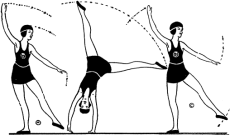
compilation of Muybridge pics including a cartwheel of sorts.

whirl, twirl, and a girl (en vacances)

Gone-a-roving for a little bit. Will be back when the leaves start to burn. Until then, doppelgangbuster.

hot ottawa voices: Anstee, McNair & Wallace

Will be reading as part of the Tree Reading Series, “Hot Ottawa Voices”, etcetera. Will be buzzing, supposedly? Details gleaned from Facebook invite:

On Tuesday, August 10th, Tree will host Hot Ottawa Voices, where three local writers will be showcased at the Ottawa Arts Court. Performing will be Cameron Anstee, Christine McNair and Gillian Wallace. These poets are selected because they are doing interesting and creative things in the Ottawa poetry community. They should be on your radar to create more of a buzz in the near future, and chapbooks will be for sale at the reading.
 
Preceding the reading from 6:45-7:45, Claudia Radmore will lead her first of four workshops on contemporary poetry and how everything is connected: the beauty of juxtaposition, Japanese forms and grabbing inspiration. The evening commences with an open mic at 8pm, which is the second-last chance you have to enter Tree’s Origami Crane open mic competition.
August 10th, 8pm, Ottawa Arts Court (upstairs)http://www.treereadingseries.ca/

not the less

These things are not the less poetry, quia carent vate sacro [because they lack a sacred bard]. They are the episodes of that cyclic poem written by Time upon the memories of men. Percy Bysshe Shelley

come out of the circle of time & into the

online mindfulness bell: http://www.mindfulnessdc.org/bell/index.html

orbital resonance

In celestial mechanics, an orbital resonance occurs when two orbiting bodies exert a regular, periodic gravitational influence on each other, usually due to their orbital periods being related by a ratio of two small integers. Orbital resonances greatly enhance the mutual gravitational influence of the bodies.

In most cases, this results in an unstable interaction, in which the bodies exchange momentum and shift orbits until the resonance no longer exists. Under some circumstances, a resonant system can be stable and self correcting, so that the bodies remain in resonance. Examples are the 1:2:4 resonance of Jupiter’s moons Ganymede, Europa and Io, and the 2:3 resonance between Pluto and Neptune. Unstable resonances with Saturn’s inner moons give rise to gaps in the rings of Saturn.

The special case of 1:1 resonance (between bodies with similar orbital radii) causes large Solar System bodies to clear the neighborhood around their orbits by ejecting nearly everything else around them; this effect is used in the current definition of a planet.

(Gravity cannot be held responsible for people falling in love. A. Einstein)

http://en.wikipedia.org/wiki/Orbital_resonance

letter from paul celan to his wife gisèle

What can I offer you, my dear Gisèle?

Here is a poem written while thinking of you—here it is just as I wrote
it down, right off , in its first version, unaltered, unchanged.

Happy birthday!

Il y aura quelque chose, plus tard,
qui se remplit (se remplira) de toi
et se hisse(ra)
à (la hauteur d’) une bouche

De mon (Du milieu de) délire (ma folie)
volé(e) en éclats
je me dresse (m’érige)
et contemple ma main
qui trace
l’un, l’unique
cercle

[There will be something, later,
that brims full with you
and lifts up
toward a mouth

Out of a shardstrewn
craze
I stand up
and look upon my hand,
how it draws the one
and only
circle]

(1970)

manual of engineering drawing (1911)

By the term Engineering Drawing is meant drawing as used in the industrial world by engineers and designers, as the language in which is expressed and recorded the ideas and information necessary for the building of machines and structures; as distinguished from drawing as a fine art, as practised by artists in pictorial representation.

The artist strives to produce, either from the model or landscape before him, or through his creative imagination, a picture which will impart to the observer something as nearly as may be of the same mental impression as that produced by the object itself, or as that in the artist’s mind. As there are no lines in nature, if he is limited in his medium to lines instead of color and light and shade, he is able only to suggest his meaning, and must depend upon the observer’s imagination to supply the lack.

The engineering draftsman has a greater task. Limited to outline alone, he may not simply suggest his meaning, but must give exact and positive information regarding every detail of the machine or structure existing in his imagination. Thus drawing to him is more than pictorial representation; it is a complete graphical language, by whose aid he may describe minutely every operation necessary, and may keep a complete record of the work
for duplication or repairs.

In the artist’s case the result can be understood, in greater or less degree, by any one. The draftsman’s result does not show the object as it would appear to the eye when finished, consequently his drawing can be read and understood only by one trained in the language.

When this language is written exactly and accurately, it is done with the aid of mathematical instruments, and is called mechanical drawing. When done with the unaided hand, without the assistance of instruments or appliances, it is known as freehand drawing, or technical sketching. Training in both these methods is necessary for the engineer, the first to develop accuracy of measurement and manual dexterity, the second to train in comprehensive observation, and to give control and mastery of form and proportion.

Our object then is to study this language so that we may write it, express ourselves clearly to one familiar with it, and may read it readily when written by another. To do this we must know the alphabet, the grammar and the composition, and be familiar with the idioms, the accepted conventions and the abbreviations.

This new language is entirely a graphical or written one. It cannot be read aloud, but is interpreted by forming a mental picture of the subject represented; and the student’s success in it will be indicated not alone by his skill in execution, but by his ability to interpret his impressions, to visualize clearly in space.


http://www.archive.org/stream/manualofengineer00frenrich/manualofengineer00frenrich_djvu.txt

half and full gilt finishing: W.J.E. Crane 1888

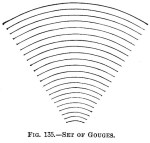
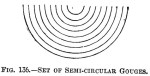
As all combinations are composed of a variety of ornamental tools and plain lines, it becomes of necessity not only a matter of taste but of expense with the binder in the selection of the former; but of the latter, it will be economical to possess himself of such as he will find constantly required, or being newly introduced into almost every design he may wish to execute. The cost of a set of gouges, half-circles and plain lines, will be trifling, and their frequent application renders them necessary. He will also find that a similar set of circles and three-quarter circles, though not so constantly required, are not less requisite where work of a superior character is executed.

Each shape can be had as a single line (broad or narrow), a double line, a dotted line, a thick and thin line, or a thick and double thin line.

… First ascertain the centre of the back. This can be done by measuring at the head and tail with a pair of compasses or spring dividers. By holding a runner to these two marks, the centre of the space between the bands can be marked off with the points of a folder. Now heat the pallet and the tool slightly on the gas stove, and work them in their places with a slight impression only. Next wash the back with some vinegar, and pass over it, with the grain of the leather, a small, hard, clean, short-haired brush. When dry, glair the impressions made by the pallet and tool, applying the glair with a small camel’s hair pencil. When the glaire is dry, apply a second coat in the same manner. When the second application is dry, rub the places over with the oiled cotton wool previously mentioned.

Next take a leaf of gold from the gold-book, put it on the gold-cushion, and cut it with the gold-knife into pieces a shade larger than the glaired spaces. Lift them by a piece of cotton wool which has been drawn over the operator’s head to render it slightly greasy. Place each piece of gold leaf in its place and press it down in the pattern. If there are any holes or breaks, breathe slightly on the gold leaf and put another piece on the top of it. When all the places are covered, begin to work the tools. These require to be heated to such a temperature that if you let fall a drop of water upon them it does not hiss or roll off, but dries up at once. Work all the tools exactly in the blind impressions.